2015 Toyota Tacoma Owner’s Manual — Front passenger occupant classification system
Before driving
Your vehicle is equipped with a front passenger occupant classification system. This system detects the conditions of the right front passenger seat and activates or deactivates the devices for the front passenger.
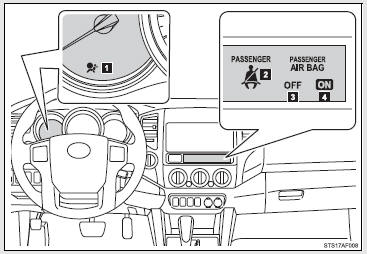
1. SRS warning light
2. Front passenger’s seat belt reminder light
3. AIR BAG OFF indicator light
4. AIR BAG ON indicator light
Conditions and operation of the front passenger occupant classification system
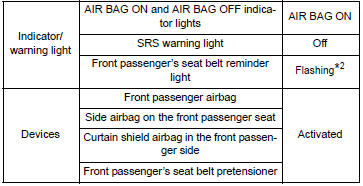
■ Adult*1
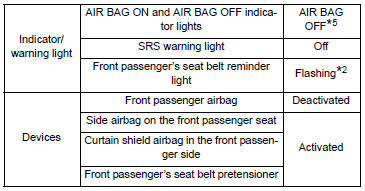
■ Child*3 or child restraint system*4
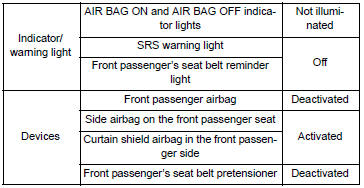
■ Unoccupied
■ There is a malfunction in the system
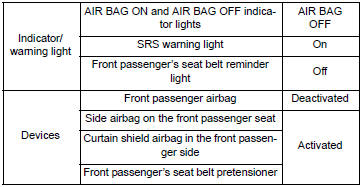
*1: The system judges a person of adult size as an adult. When a smaller adult sits in the front passenger seat, the system may recognize him/her as a child depending on his/her physique and posture.
*2: In the event the front passenger does not wear a seat belt.
*3: When a larger child who has outgrown a child restraint system sits in the front passenger seat, the system may recognize him/ her as an adult depending on his/her physique or posture.
*4: Never install a rear-facing child restraint system on the front passenger seat. A forward-facing child restraint system should only be installed on the front passenger seat when it is unavoidable.
*5: In case the indicator is not illuminated, consult this manual for installing the child restraint system properly.
CAUTION
■Front passenger occupant classification system precautions
Observe the following precautions regarding front passenger occupant classification system.
Failure to do so may cause death or serious injury.
●Wear the seat belt properly.
●Make sure the front passenger’s seat belt tab has not been left inserted into the buckle before someone sits in the front passenger seat.
●Make sure the AIR BAG OFF indicator light is not illuminated when using the seat belt extender for the front passenger seat. If the AIR BAG OFF indicator light is illuminated, disconnect the extender tongue from the seat belt buckle, then reconnect the seat belt. Reconnect the seat belt extender after making sure the AIR BAG ON indicator light is illuminated. If you use the seat belt extender while the AIR BAG OFF indicator light is illuminated, the SRS airbags for the passenger may not activate correctly, which could cause death or serious injury in the event of collision.
●Do not place a heavy load on the front passenger seat or equipment (e.g.
seatback table).
●Do not apply pressure to the front passenger seat by resting hands or legs on the seatback.
●Do not let a rear passenger lift the front passenger seat with their feet or press on the seatback with their legs.
●Do not put objects under the front passenger seat.
CAUTION
■Front passenger occupant classification system precautions
●Do not recline the front passenger seatback so far that it touches a rear seat or a back wall. This may cause the AIR BAG OFF indicator light to be illuminated, which indicates that the passenger’s airbags will not deploy in the event of a severe accident. If the seatback touches the rear seat or back wall, return the seatback to a position where it does not touch the rear seat or back wall. Keep the front passenger seatback as upright as possible when the vehicle is moving. Reclining the seatback excessively may lessen the effectiveness of the seat belt system.
●If an adult sits in the front passenger seat, the AIR BAG ON indicator light is illuminated. If the AIR BAG OFF indicator is illuminated, ask the passenger to sit up straight, well back in the seat, feet on the floor, and with the seat belt worn correctly. If the AIR BAG OFF indicator still remains illuminated, either ask the passenger to move to the rear seat, or if that is not possible, move the front passenger seat fully rearward.
●When it is unavoidable to install the forward-facing child restraint system on the front passenger seat, install the child restraint system on the front passenger seat in the proper order.
●Do not modify or remove the front seats.
●Do not kick the front passenger seat or subject it to severe impact. Otherwise, the SRS warning light may come on to indicate a malfunction of the detection system. In this case, contact your Toyota dealer immediately.
●Child restraint systems installed on the rear seat should not contact the front seatbacks.
●Do not use a seat accessory, such as a cushion or seat cover, that covers the seat cushion surface.
●Access Cab and Double Cab models: Do not attach a commercial seatback table or other heavy item to the back of the front passenger seat.
●Do not modify or replace the upholstery of the front seat.
Child restraint systems
A child restraint system for a small child or baby must itself be properly restrained on the seat with the lap portion of the lap/shoulder belt.
The laws of all 50 states of the U.S.A. and Canada now require the use of child restraint systems.
Points to remember
Studies have shown that installing a child restraint on a rear seat is much safer than installing one to the front passenger seat.
● Choose a child restraint system that suits your vehicle and is appropriate to the age and size of the child.
● For installation details, follow the instructions provided with the child restraint system.
General installation instructions are provided in this manual.
Types of child restraints
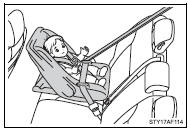
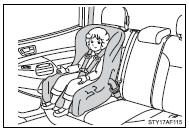
Child restraint systems are classified into the following 3 types according to the age and size of the child.
 Rear facing — Infant seat/convertible seat (Access Cab and Double Cab models only)
 Forward facing — Convertible seat
 Booster seat
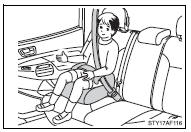
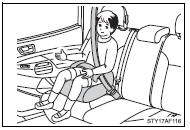
■Selecting an appropriate child restraint system
●Use a child restraint system appropriate for the child until the child becomes large enough to properly wear the vehicle’s seat belt.
●If a child is too large for a child restraint system, sit the child on a rear seat and use the vehicle’s seat belt.
CAUTION
■Child restraint precautions
●For effective protection in automobile accidents and sudden stops, a child must be properly restrained, using a seat belt or child restraint system depending on the age and size of the child. Holding a child in your arms is not a substitute for a child restraint system. In an accident, the child can be crushed against the windshield, or between you and the vehicle’s interior.
●Regular Cab models: Toyota strongly urges use of a proper child restraint system which conforms to the size of the child.
●Access Cab and Double Cab models: Toyota strongly urges the use of a proper child restraint system that conforms to the size of the child, installed on the rear seat. According to accident statistics, the child is safer when properly restrained in the rear seat than in the front seat.
●Never install a rear-facing child restraint system on the front passenger seat even if the AIR BAG OFF indicator light is illuminated. In the event of an accident, the force of the rapid inflation of the front passenger airbag can cause death or serious injury to the child if the rear-facing child restraint system is installed on the front passenger seat.
●Access Cab and Double Cab models: A forward-facing child restraint system may be installed on the front passenger seat only when it is unavoidable.
A child restraint system that requires a top tether strap should not be used in the front passenger seat since there is no top tether strap anchor for the front passenger seat. Adjust the seatback as upright as possible and always move the seat as far back as possible even if AIR BAG OFF indicator light is illuminated, because the front passenger airbag could inflate with considerable speed and force. Otherwise, the child may be killed or seriously injured.
●Bench type front seat: Do not install a child restraint system on the center seat if it interferes with driving operations such as gear shifting. In this case, install the child restraint system on the right passenger seat.
●Bench type front seat: The driver and passengers sit on a bench seat in this vehicle. Therefore, when installing a child restraint system, the seat must be moved back from the SRS airbag as far as possible while also maintaining the driver’s seating position. Otherwise, the force of the rapid inflation of the airbag could cause death or serious injury to the child.
CAUTION
■Child restraint precautions
●Do not use the seat belt extender when installing a child restraint system on the front or rear passenger seat. If installing a child restraint system with the seat belt extender connected to the seat belt, the seat belt will not securely hold the child restraint system, which could cause death or serious injury to the child or other passengers in the event of a sudden stop, sudden swerve or an accident.
●Do not allow the child to lean his/her head or any part of his/her body against the door or the area of the seat, front and rear pillars or roof side rail from which the side airbags or curtain shield airbags deploy even if the child is seated in the child restraint system. It is dangerous if the side airbags and curtain shield airbags inflate, and the force of the rapid inflation could cause death or serious injury to the child.
●Make sure you have complied with all installation instructions provided by the child restraint manufacturer and that the system is properly secured. If it is not secured properly, it may cause death or serious injury to the child in the event of a sudden stop, sudden swerve or an accident.
■When children are in the vehicle
Do not allow children to play with the seat belt. If the seat belt becomes twisted around a child’s neck, it may lead to choking or other serious injuries that could result in death. If this occurs and the buckle cannot be unfastened, scissors should be used to cut the belt.
■When the child restraint system is not in use
●Keep the child restraint system properly secured on the seat even if it is not in use. Do not store the restraint unsecured in the passenger compartment.
●If it is necessary to detach the child restraint system, remove it from the vehicle. This will prevent it from injuring passengers in the event of a sudden stop, sudden swerve or an accident.
Installing child restraints
Follow the child restraint system manufacturer’s instructions. Firmly secure child restraints to the seats using the LATCH anchors or a seat belt. Attach the top tether strap when installing a child restraint.
The lap/shoulder belt can be used if your child restraint system is not compatible with the LATCH (Lower Anchors and Tethers for Children) system.
■ Using the LATCH anchors
 Access Cab models
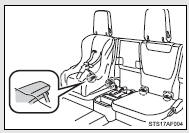
Child restraint LATCH anchors
LATCH anchors are provided for the each rear seat.
 Double Cab models
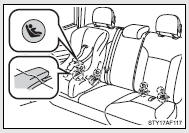
Child restraint LATCH anchors
LATCH anchors are provided for the outside rear seats.
Buttons displaying the location of the anchors are attached to the seats.
■ Using the seat belts
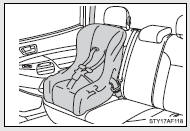
Seat belts equipped with a child restraint locking mechanism (ALR/ELR belts except driver’s seat belt)
■ Using the top tether strap
 Regular Cab models with bench type seat
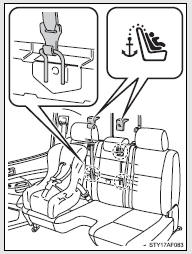
Anchor bracket (for top tether strap)
Anchor bracket is provided for each passenger seat.
 Regular Cab models with separated type seat
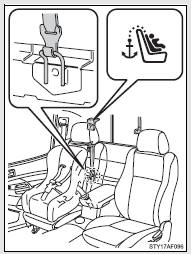
Anchor bracket (for top tether strap)
Anchor bracket is provided for passenger seat.
 Access Cab models
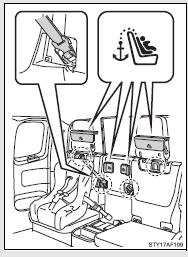
Anchor bracket (for top tether strap)
Anchor bracket is provided for each rear seat.
 Double Cab models
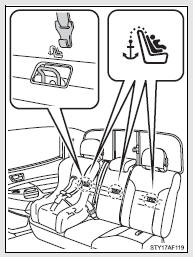
Anchor bracket (for top tether strap) Anchor bracket is provided for each rear seat.
Installation with LATCH system (Access Cab models)
 Type A
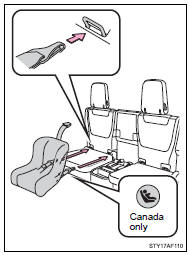
 Latch the hooks of the lower straps onto the LATCH anchors and tighten the lower straps.
 If the child restraint has a top tether strap, the top tether strap should be latched onto the top tether strap anchor.
For owners in Canada: A symbol on a child restraint system indicates the presence of a lower connector system.
Type B
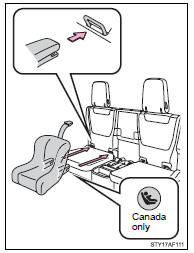
 Latch the buckles onto the LATCH anchors.
 If the child restraint has a top tether strap, the top tether strap should be latched onto the top tether strap anchor.
For owners in Canada: A symbol on a child restraint system indicates the presence of a lower connector system.
Installation with LATCH system (Double Cab models)
 Type A
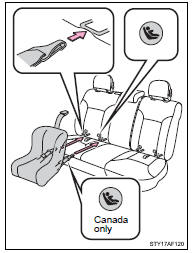
 Widen the gap between the seat cushion and seatback slightly.
 Latch the hooks of the lower straps onto the LATCH anchors and tighten the lower straps.
 If the child restraint has a top tether strap, the top tether strap should be latched onto the top tether strap anchor.
For owners in Canada: A symbol on a child restraint system indicates the presence of a lower connector system.
 Type B
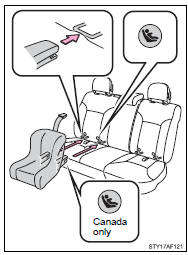
 Widen the gap between the seat cushion and seatback slightly.
 Latch the buckles onto the LATCH anchors.
 If the child restraint has a top tether strap, the top tether strap should be latched onto the top tether strap anchor.
For owners in Canada: A symbol on a child restraint system indicates the presence of a lower connector system.
Installing child restraints using a seat belt (child restraint lock function belt)
■ Rear-facing (Regular Cab models) — Infant seat/convertible seat
Never install a rear-facing child restraint. Your vehicle is not designed to carry an infant.
■ Rear-facing (Access Cab and Double Cab models) ⎯ Infant seat/convertible seat
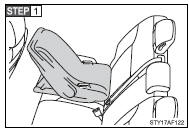
Place the child seat on the rear seat facing the rear of the vehicle.
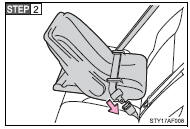
Run the seat belt through the child seat and insert the plate into the buckle. Make sure that the belt is not twisted.
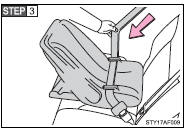
Fully extend the shoulder belt and then allow it to retract slightly in order to activate the ALR lock mode.
Lock mode allows the seat belt to retract only.
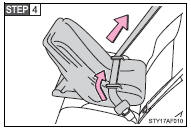
While pushing the child seat down into the rear seat, allow the shoulder belt to retract until the child seat is securely in place.
After the shoulder belt has retracted to a point where there is no slack in the belt, pull the belt to check that it cannot be extended.
■ Forward-facing ⎯ Convertible seat
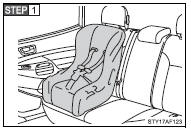
Place the child seat on the seat facing the front of the vehicle.
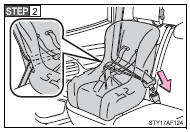
Run the seat belt through the child seat and insert the plate into the buckle. Make sure that the belt is not twisted.
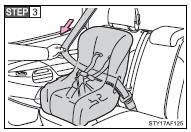
Fully extend the shoulder belt and then allow it to retract slightly in order to activate the ALR lock mode.
Lock mode allows the seat belt to retract only.
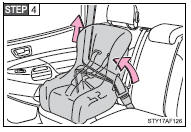
While pushing the child seat into the seat, allow the shoulder belt to retract until the child seat is securely in place.
After the shoulder belt has retracted to a point where there is no slack in the belt, pull the belt to check that it cannot be extended.
 If the child restraint has a top tether strap, the top tether strap should be latched onto the top tether strap anchor.
■ Booster seat
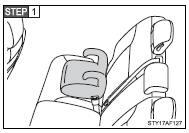
Place the booster seat on the seat facing the front of the vehicle.
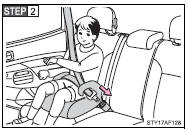
Sit the child in the booster seat.
Fit the seat belt to the booster seat according to the manufacturer’s instructions and insert the plate into the buckle. Make sure that the belt is not twisted.
Check that the shoulder belt is correctly positioned over the child’s shoulder, and that the lap belt is as low as possible.
Removing a child restraint installed with a seat belt
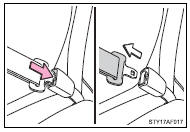
Push the buckle release button and fully retract the seat belt.
Child restraint systems with a top tether strap (Regular Cab models)
■ Bench type seat
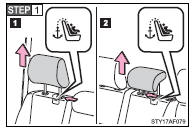
Remove the head restraint.
Installing position:
 Right side passenger seat
 Center passenger seat
Swing the seatback forward slightly (→P. 48) and remove the anchor bracket covers.
Installing position:
 Right side passenger seat
 Center passenger seat
Store the removed cover in a safe place such as the glove box.
 Right side passenger seat
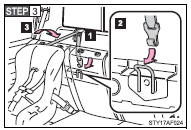
 Route the top tether strap through the routing device as shown in the illustration.
Make sure the top tether strap is not twisted.
 Latch the hook onto the anchor bracket.
 Return the seatback to its original position.
Make sure the seatback is securely locked by pushing forward and rearward on the top of the seatback.
 Center passenger seat
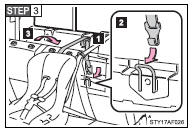
 Route the top tether strap through the routing device as shown in the illustration.
Make sure the top tether strap is not twisted.
 Latch the hook onto the anchor bracket.
 Return the seatback to its original position.
Make sure the seatback is securely locked by pushing forward and rearward on the top of the seatback.
 Secure the child restraint using a seat belt or lower anchors, and tighten the top tether strap.
Make sure the top tether strap is securely latched.
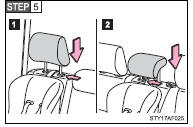
Replace the head restraint.
Installing position:
 Right side passenger seat
 Center passenger seat
■ Separated type seat
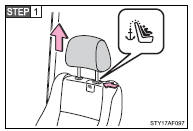
Remove the head restraint.
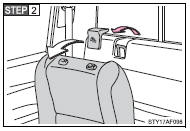
Swing the seatback forward slightly (→P. 47) and remove the anchor bracket cover.
Store the removed cover in a safe place such as the glove box.
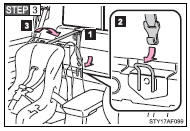
 Route the top tether strap through the routing device as shown in the illustration.
Make sure the top tether strap is not twisted.
 Latch the hook onto the anchor bracket.
 Return the seatback to its original position.
Make sure the seatback is securely locked by pushing forward and rearward on the top of the seatback.
 Secure the child restraint using a seat belt or lower anchor, and tighten the top tether strap.
Make sure the top tether strap is securely latched.
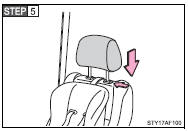
Replace the head restraint.
Child restraint systems with a top tether strap (Access Cab models)
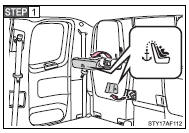
Remove the anchor bracket covers.
Store the removed covers in a safe place such as the glove box.
 Secure the child restraint using a seat belt or lower anchors.
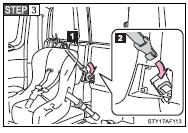
 Route the top tether strap through the routing device as shown in the illustration.
Make sure the top tether strap is not twisted.
 Latch the hook onto the anchor bracket and tighten the top tether strap.
Make sure the top tether strap is securely latched.
Child restraint systems with a top tether strap (Double Cab models)
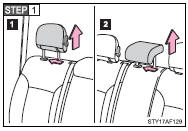
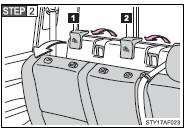
Remove the head restraint.
Installing position:
 Outside passenger seat
 Center passenger seat
 Outside passenger seat
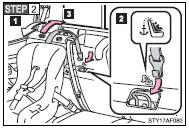
 Swing the seatback forward slightly.
 Latch the hook onto the anchor bracket.
 Return the seatback to its original position.
Make sure the seatback is securely locked by pushing forward and rearward on the top of the seatback.
 Center passenger seat
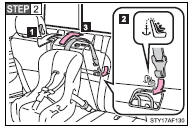
 Swing the seatback forward slightly.
 Latch the hook onto the anchor bracket.
 Return the seatback to its original position.
Make sure the seatback is securely locked by pushing forward and rearward on the top of the seatback.
 Secure the child restraint using a seat belt or lower anchors, and tighten the top tether strap.
Make sure the top tether strap is securely latched.
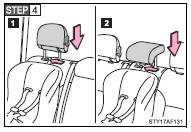
Replace the head restraint.
Installing position:
 Outside passenger seat
 Center passenger seat
■Laws and regulations pertaining to anchorages
The LATCH system conforms to FMVSS225 or CMVSS210.2.
Child restraint systems conforming to FMVSS213 or CMVSS213 specifications can be used.
This vehicle is designed to conform to the SAE J1819.
CAUTION
■When installing a booster seat
Do not fully extend the shoulder belt to prevent the belt from going to ALR lock mode.
ALR mode causes the belt to tighten only which could cause injury or discomfort to the child.
■When installing a child restraint system
Follow the directions given in the child restraint system installation manual and fix the child restraint system securely in place.
If the child restraint system is not correctly fixed in place, the child or other passengers may be seriously injured or even killed in the event of sudden braking, sudden swerving or an accident.
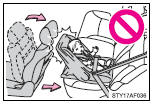
●Access Cab and Double Cab models: If the driver’s seat interferes with the child restraint system and prevents it from being attached correctly, attach the child restraint system to the right-hand rear seat.
●Access Cab and Double Cab models: Adjust the front passenger seat so that it does not interfere with the child restraint system.
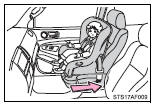
●Only put a forward-facing or booster child seat on the front seat when it is unavoidable. When installing a forwardfacing or booster child seat on the front passenger seat, move the seat as far back as possible even if AIR BAG OFF indicator light is illuminated. Failing to do so may result in death or serious injury if the airbags deploy (inflate).
CAUTION
■When installing a child restraint system
●When a booster seat is installed, always ensure that the shoulder belt is positioned across the center of the child’s shoulder. The belt should be kept away from the child’s neck, but not so that it could fall off the child’s shoulder. Failing to do so may result in death or serious injury in the event of sudden braking, sudden swerving or an accident.
●Ensure that the belt and tab are securely locked and the seat belt is not twisted.
●Push and pull the child restraint system from side to side and forward to be sure it is secure.
●After securing the child restraint system, never adjust the seat.
●Follow all installation instructions provided by the child restraint system manufacturer.
■Do not use a seat belt extender
If a seat belt extender is used when installing a child restraint system, the seat belt will not securely hold the child restraint system, which could cause death or serious injury to the child or other passengers in the event of sudden braking, sudden swerving or an accident.
■To correctly attach a child restraint system to the anchors
When using the LATCH anchors, be sure that there are no foreign objects around the anchors and that the seat belt is not caught behind the child restraint. Make sure the child restraint system is securely attached, or it may cause death or serious injury to the child or other passengers in the event of a sudden stop, sudden swerve or accident.
Stored owner’s manualImported HTML from the shared Autotk manuals tables. Not an official Toyota site.