2015 Toyota Tacoma Owner’s Manual — Do-it-yourself maintenance
When trouble arises
Do-it-yourself service precautions
If you perform maintenance yourself, be sure to follow the correct procedures as given in these sections.
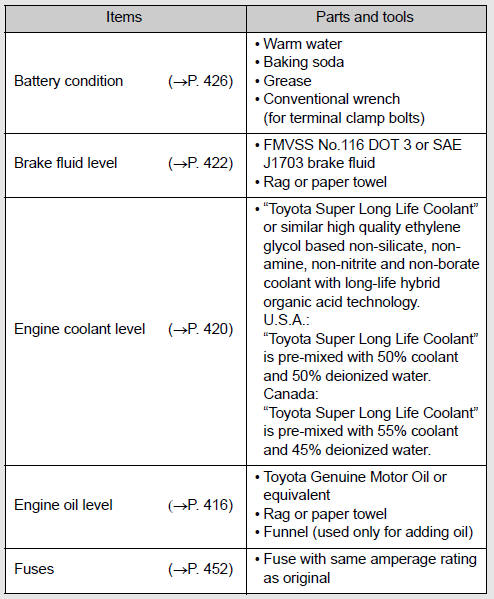
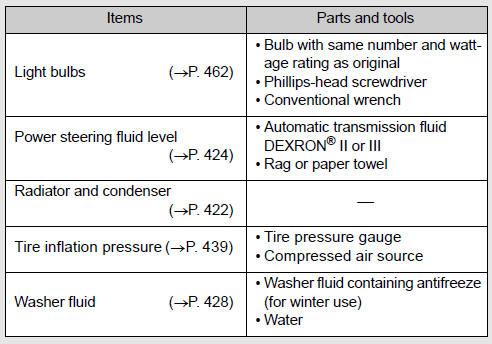
CAUTION
The engine compartment contains many mechanisms and fluids that may move suddenly, become hot, or become electrically energized. To avoid death or serious injury observe the following precautions.
■When working on the engine compartment
●Keep hands, clothing, and tools away from the moving fan and engine drive belt.
●Be careful not to touch the engine, radiator, exhaust manifold, etc. right after driving as they may be hot. Oil and other fluids may also be hot.
●Do not leave anything that may burn easily, such as paper or rags, in the engine compartment.
●Do not smoke, cause sparks or expose an open flame to fuel or the battery.
Fuel and battery fumes are flammable.
●Be extremely cautious when working on the battery. It contains poisonous and corrosive sulfuric acid.
●Take care because brake fluid can harm your hands or eyes and damage painted surfaces.
If fluid gets on your hands or in your eyes, flush the affected area with clean water immediately.
If you still experience discomfort, see a doctor.
■When working near the cooling fan or radiator grille
Be sure the engine switch is off.
With the engine switch on, the cooling fan may automatically start to run if the air conditioning is on and/or the coolant temperature is high.
■Safety glasses
Wear safety glasses to prevent flying or falling material, fluid spray, etc. from getting in the eyes.
NOTICE
■If you remove the air cleaner
Driving with the air cleaner removed may cause excessive engine wear due to dirt in the air.
■If the fluid level is low or high
It is normal for the brake fluid level to go down slightly as the brake pads wear or when the fluid level in the accumulator is high.
If the reservoir needs frequent refilling, it may indicate a serious problem.
Hood
Release the lock from the inside of the vehicle to open the hood.
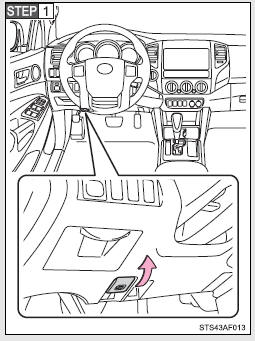
Pull the hood release lever.
The hood will pop up slightly.
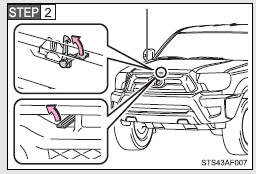
Pull up the hood catch lever and lift the hood.
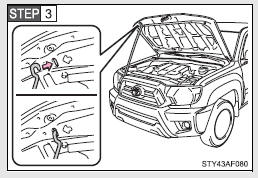
Hold the hood open by inserting the supporting rod into the slot.
CAUTION
■Pre-driving check
Check that the hood is fully closed and locked.
If the hood is not locked properly, it may open while the vehicle is in motion and cause an accident, which may result in death or serious injury.
■After installing the support rod into the slot
Make sure the rod supports the hood securely from falling down on to your head or body.
NOTICE
■When closing the hood
Be sure to return the support rod to its clip before closing the hood. Closing the hood with the support rod up could cause the hood to bend.
Engine compartment
 2.7 L 4-cylinder (2TR-FE) engine
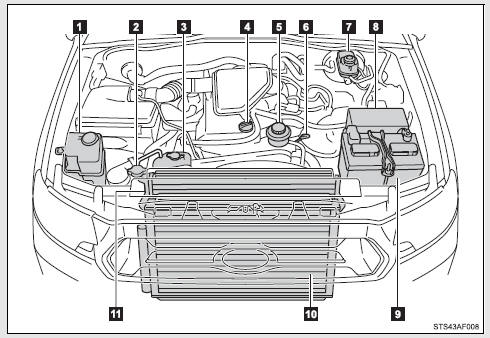
1. Washer fluid tank
2.Radiator cap
3.Engine coolant reservoir
4. Engine oil filler cap
5. Power steering fluid reservoir
6. Engine oil level dipstick
7. Brake fluid reservoir
8. Fuse box
9. Battery
10. Condenser
11. Radiator
 4.0 L V6 (1GR-FE) engine
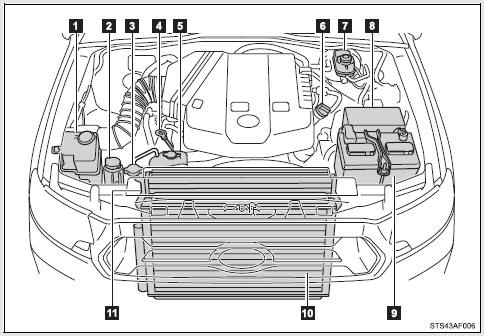
1. Washer fluid tank
2. Power steering fluid reservoir
3. Radiator cap
4.Engine oil level dipstick
5.Engine coolant reservoir
6. Engine oil filler cap
7. Brake fluid reservoir
8. Fuse box
9. Battery
10. Condenser
11. Radiator
Engine oil
With the engine at operating temperature and turned off, check the oil level on the dipstick.
■ Checking the engine oil
 Park the vehicle on level ground. After warming up the engine and turning it off, wait more than 5 minutes for the oil to drain back into the bottom of the engine.
 Hold a rag under the end and pull the dipstick out.
 2.7 L 4-cylinder (2TR-FE) engine
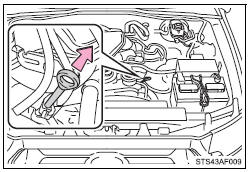
4.0 L V6 (1GR-FE) engine
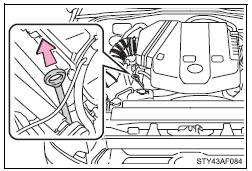
 Wipe the dipstick clean.
 Reinsert the dipstick fully.
 Holding a rag under the end, pull the dipstick out and check the oil level.
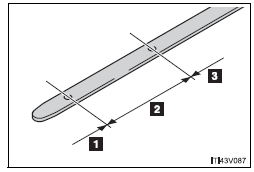
1. Low
2. Normal
3. Excessive
The shape of the dipstick may differ depending on the type of vehicle or engine.
 Wipe the dipstick and reinsert it fully.
■ Adding engine oil
 2.7 L 4-cylinder (2TR-FE) engine
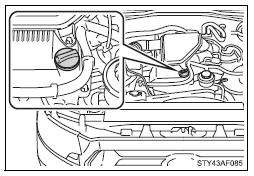
If the oil level is below or near the low level mark, add engine oil of the same type as already in the engine.
 4.0 L V6 (1GR-FE) engine
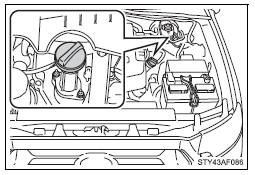
Make sure to check the oil type and prepare the items needed before adding oil.

 Remove the oil filler cap, turning it counterclockwise.
 Add engine oil slowly
 Checking the dipstick.
 Reinstall the filler cap, turning it clockwise.
The approximate quantity of oil needed to raise the level between low and full on the dipstick is indicated as follows:
 2.7 L 4-cylinder (2TR-FE) engine
1.4 qt. (1.3 L, 1.1 lmp.qt.)
 4.0 L V6 (1GR-FE) engine
1.6 qt. (1.5 L, 1.3 lmp.qt.)
■Engine oil consumption
A certain amount of engine oil will be consumed while driving. In the following situations, oil consumption may increase, and engine oil may need to be refilled in between oil maintenance intervals.
●When the engine is new, for example directly after purchasing the vehicle or after replacing the engine
●If low quality oil or oil of an inappropriate viscosity is used
●When driving at high engine speeds or with a heavy load, when towing, or when driving while accelerating or decelerating frequently
●When leaving the engine idling for a long time, or when driving frequently through heavy traffic
CAUTION
■Used engine oil
●Used engine oil contains potentially harmful contaminants which may cause skin disorders such as inflammation or skin cancer, so care should be taken to avoid prolonged and repeated contact. To remove used engine oil from your skin, wash thoroughly with soap and water.
●Dispose of used oil and filters only in a safe and acceptable manner. Do not dispose of used oil and filters in household trash, in sewers or onto the ground. Call your Toyota dealer, service station or auto parts store for information concerning recycling or disposal.
●Do not leave used engine oil within the reach of children.
NOTICE
■To prevent serious engine damage
Check the oil level on regular basis.
■When replacing the engine oil
●Be careful not to spill engine oil on the vehicle components.
●Avoid overfilling, as the engine could be damaged.
●Check the oil level on the dipstick every time you refill the vehicle.
●Be sure the engine oil filler cap is properly tightened.
Engine coolant
The coolant level is satisfactory if it is between the FULL and LOW lines on the reservoir when the engine is cold.
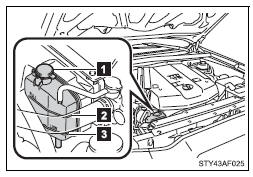
1. Reservoir cap
2. FULL line
3. LOW line
If the level is on or below the LOW line, add coolant up to the FULL line.
■If the coolant level drops within a short time after replenishing
Visually check the radiator, hoses, reservoir cap, radiator cap, drain cock and water pump.
If you cannot find a leak, have your Toyota dealer pressure test the cap and check for leaks in the cooling system.
■Coolant selection
Only use “Toyota Super Long Life Coolant” or similar high quality ethylene glycol based non-silicate, non-amine, non-nitrite and non-borate coolant with long-life hybrid organic acid technology.
U.S.A.: “Toyota Super Long Life Coolant” is a mixture of 50% coolant and 50% deionized water. (Enabled: -31°F [-35°C])
Canada:“Toyota Super Long Life Coolant” is a mixture of 55% coolant and 45% deionized water. (Enabled: -44°F [-42°C])
For more details about engine coolant, contact your Toyota dealer.
CAUTION
■When the engine is hot
Do not remove the radiator cap.
The cooling system may be under pressure and may spray hot coolant if the cap is removed, causing serious injuries, such as burns.
NOTICE
■When adding engine coolant
Coolant is neither plain water nor straight antifreeze. The correct mixture of water and antifreeze must be used to provide proper lubrication, corrosion protection and cooling. Be sure to read the antifreeze or coolant label.
■If you spill coolant
Be sure to wash it off with water to prevent damage to parts or paint.
Radiator and condenser
Check the radiator and condenser and clear any foreign objects.
If either of the above parts are extremely dirty or you are not sure of their condition, have your vehicle checked by your Toyota dealer.
CAUTION
■When the engine is hot
Do not touch the radiator or condenser as they may be hot and cause serious injuries, such as burns.
Brake fluid
■ Checking fluid level
 Type A
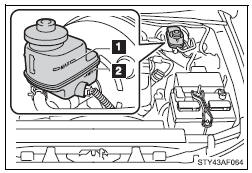
The brake fluid level should be between the MAX and MIN lines on the reservoir.
1. MAX line
2. MIN line
 Type B
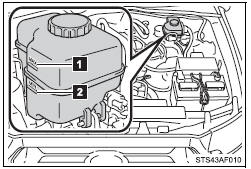
1.
MAX line
2.
MIN line
■ Adding fluid
Make sure to check the fluid type and prepare the necessary items.

 Type B only
 Turn the engine off.
 Depress the brake pedal 20 times or more.
 Remove the reservoir cap.
 Add newly opened brake fluid up to the MAX line.
■Brake fluid can absorb moisture from the air
Excess moisture in the fluid can cause a dangerous loss of braking efficiency.
Use only newly opened brake fluid.
CAUTION
■When filling the reservoir
Take care because brake fluid can harm your hands or eyes and damage painted surfaces.
If fluid gets on your hands or in your eyes, flush the affected area with clean water immediately.
If you still experience discomfort, see a doctor.
NOTICE
■If the fluid level is low or high
It is normal for the brake fluid level to go down slightly as the brake pads wear or when the fluid level in the accumulator is high.
If the reservoir needs frequent refilling, it may indicate a serious problem.
■If you spill fluid
Be sure to wash it off with water to prevent damage to parts or paint.
Power steering fluid
■ Fluid level
The fluid level should be within the appropriate range.
 2.7 L 4-cylinder (2TR-FE) engine
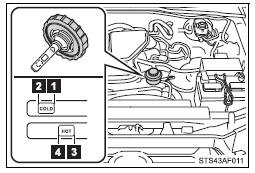
1. Full (when cold)
2. Add fluid (when cold)
3. Full (when hot)
4. Add fluid (when hot)
Hot: Vehicle has been driven around 50 mph (80 km/h) for 20 minutes, or slightly longer in frigid temperatures. (Fluid temperature, 104°F - 175°F [40°C - 80°C])
Cold: Engine has not been run for about 5 hours. (Room temperature, 32°F - 104°F [0°C - 40°C])
 4.0 L V6 (1GR-FE) engine
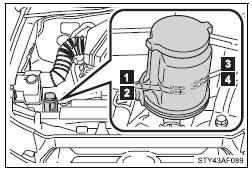
1. Full (when cold)
2. Add fluid (when cold)
3. Full (when hot)
4. Add fluid (when hot)
Hot: Vehicle has been driven around 50 mph (80 km/h) for 20 minutes, or slightly longer in frigid temperatures. (Fluid temperature, 140°F - 175°F [60°C - 80°C])
Cold: Engine has not been run for about 5 hours. (Room temperature, 50°F - 85°F [10°C - 30°C])
■ Checking the fluid level
Make sure to check the fluid type and prepare the necessary items.

 Clean all dirt off the reservoir.
 Remove the cap by turning it counterclockwise.
 Wipe the dipstick clean.
 Reinstall and remove the reservoir cap again.
 Check the fluid level.
CAUTION
■Checking the fluid level
Take care, as the reservoir may be hot.
NOTICE
■When adding fluid
Avoid overfilling, or the power steering may be damaged.
■After replacing the reservoir cap
Check the steering box case, vane pump and hose connections for leaks or damage.
Battery
■ Battery exterior
Make sure that the battery terminals are not corroded and that there are no loose connections, cracks, or loose clamps.
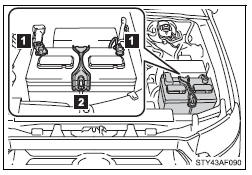
1. Terminals
2. Hold-down clamp
■Before recharging
When recharging, the battery produces hydrogen gas which is flammable and explosive. Therefore, before recharging: ●If recharging with the battery installed on the vehicle, be sure to disconnect the ground cable.
●Make sure the power switch on the charger is off when connecting and disconnecting the charger cables to the battery.
CAUTION
■Chemicals in the battery
A battery contains poisonous and corrosive sulfuric acid and may produce hydrogen gas which is flammable and explosive. To reduce the risk of death or serious injury, take the following precautions while working on or near battery: ●Do not cause sparks by touching the battery terminals with tools.
●Do not smoke or light a match near the battery.
●Avoid contact with eyes, skin and clothes.
●Never inhale or swallow electrolyte.
●Wear protective safety glasses when working near the battery.
●Keep children away from the battery.
■Where to safety charge the battery
Always charge the battery in an open area. Do not charge the battery in a garage or closed room where there is not sufficient ventilation.
■How to recharge the battery
Only perform a slow charge (5A or less).
The battery may explode if charged at a quicker rate.
■Emergency measures regarding electrolyte
●If electrolyte gets in your eyes
Flush your eyes with clean water for at least 15 minutes and get immediate medical attention. If possible, continue to apply water with a sponge or cloth while traveling to the nearest medical facility.
●If electrolyte gets on your skin
Wash the affected area thoroughly. If you feel pain or burning, get medical attention immediately.
●If electrolyte gets on your clothes
It can soak through clothing on to your skin. Immediately take off the clothing and follow the procedure above if necessary.
●If you accidentally swallow electrolyte
Drink a large quantity of water or milk. Get emergency medical attention immediately.
NOTICE
■When recharging the battery
Never recharge the battery while the engine is running. Also, be sure all accessories are turned off.
Washer fluid
If the washer does not work, the washer tank may be empty.
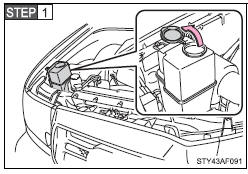
Open the lid.
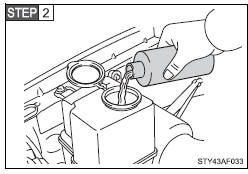
Add washer fluid.
CAUTION
■When refilling the washer fluid
Do not refill the washer fluid when the engine is hot or running, as the washer fluid contains alcohol and may catch fire if spilled on the engine etc.
NOTICE
■Do not use any fluid other than washer fluid
Do not use soapy water or engine antifreeze instead of washer fluid.
Doing so may cause streaking on the vehicle’s painted surfaces.
■Diluting washer fluid
Dilute washer fluid with water as necessary.
Refer to the freezing temperatures listed on the label of the washer fluid bottle.
Tires
Replace or rotate tires in accordance with maintenance schedules and treadwear.
■ Checking tire
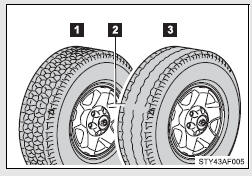
1. New tread
2. Treadwear indicator
3. Worn tread
The location of treadwear indicators is shown by the “TWI” or “ ” marks, etc., molded on the sidewall of each tire.
Check spare tire condition and inflation pressure if not rotated.
■ Tire rotation
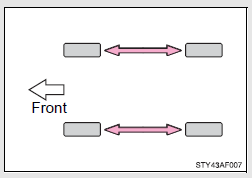
Rotate the tires in the order shown.
To equalize tire wear and extend tire life, Toyota recommends that tire rotation is carried out at the same interval as tire inspection.
Vehicles with P215/70R15 and P265/70R16 tires: Do not fail to initialize the tire pressure warning system after tire rotation.
■ The tire pressure warning system
Your Toyota is equipped with a tire pressure warning system that uses tire pressure warning valves and transmitters to detect low tire inflation pressure before serious problems arise.
Installing tire pressure warning valves and transmitters
When replacing tires or wheels, tire pressure warning valves and transmitters must also be installed.
When new tire pressure warning valves and transmitters are installed, new tire pressure warning valve and transmitter ID codes must be registered in the tire pressure warning computer and tire pressure warning system must be initialized. Have tire pressure warning valve and transmitter ID codes registered by your Toyota dealer.
Initializing the tire pressure warning system
■ The tire pressure warning system must be initialized in the following circumstances:
● Vehicles with P215/70R15 and P265/70R16 tires: When rotating the tires on vehicles differing with front and rear tire inflation pressures.
● When changing the tire inflation pressure by changing traveling speed or load weight, etc.
● When changing the tire size.
When the tire pressure warning system is initialized, the current tire inflation pressure is set as the pressure benchmark.
■ How to initialize the tire pressure warning system
 Park the vehicle in safe place and turn the engine switch to the LOCK position.
While the vehicle is moving, initialization is not performed.
 Adjust the tire inflation pressure to the specified cold tire inflation pressure level.
Make sure to adjust the tire pressure to the specified cold tire inflation pressure level. The tire pressure warning system will operate based on this pressure level.
 Turn the engine switch to the ON position.
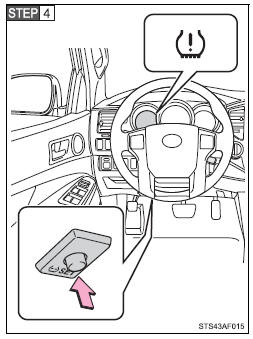
Press and hold the tire pressure warning reset switch until the tire pressure warning light blinks slowly 3 times.
 Wait for a few minutes with the engine switch in the ON position, and then turn the engine switch to the ACC or LOCK position.
Registering ID codes
The tire pressure warning valve and transmitter is equipped with a unique ID code. When replacing a tire pressure warning valve and transmitter, it is necessary to register the ID code of tire pressure warning valve and transmitter. Have the ID code registered by your Toyota dealer.
■When to replace your vehicle’s tires
Tires should be replaced if: ●You have tire damage such as cuts, splits, cracks deep enough to expose the fabric or bulges indicating internal damage
●A tire goes flat repeatedly or cannot be properly repaired due to the size or location of a cut or other damage
If you are not sure, consult with your Toyota dealer.
■Replacing tires and wheels
If the ID code of the tire pressure warning valve and transmitter is not registered, the tire pressure warning system will not work properly. After driving for about 20 minutes, the tire pressure warning light blinks for 1 minute and stays on to indicate a system malfunction.
■Tire life
Any tire over 6 years old must be checked by a qualified technician even if they have seldom or never been used or damage is not obvious.
■If the tread wears down below 0.16 in. (4 mm) on snow tires
The effectiveness of snow tires is lost.
■Maximum load of tire
Check that the number given by dividing the maximum load by 1.10 of the replacement tire is greater than 1/2 of the Gross Axle Weight Ratings (GAWR) of either the front axle or the rear axle, whichever is greater.
For the GAWR, see the Certification Label. For the maximum load of the tire, see the load limit at maximum cold tire inflation pressure mentioned on the sidewall of the tire.
 Regular Cab and Double Cab models
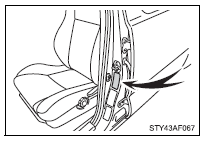
 Access Cab models
■Tire types
1 Summer tires
Summer tires are high-speed performance tires best suited to highway driving under dry conditions. Since summer tires do not have the same traction performance as snow tires, summer tires are inadequate for driving on snow-covered or icy roads. For driving on snow-covered roads or icy roads, the use of snow tires is recommended. When installing snow tires, be sure to replace all four tires.
2 All season tires
All season tires are designed to provide better traction in snow and to be adequate for driving in most winter conditions, as well as for use year round. All season tires, however, do not have adequate traction performance compared with snow tires in heavy or loose snow. Also, all season tires fall short in acceleration and handling performance compared with summer tires in highway driving.
3 Snow tires
For driving on snow-covered roads or icy roads, we recommend using snow tires. If you need snow tires, select tires of the same size, construction and load capacity as the originally installed tires. Since your vehicle has radial tires as original equipment, make sure your snow tires also have radial construction. Do not install studded tires without first checking local regulations for possible restriction. Snow tires should be installed on all wheels.
■Initializing the tire pressure warning system
Initialize the tire pressure warning system with the tire inflation pressure adjusted to the specified level.
■If you push the tire pressure warning reset switch accidentally
If initialization is performed, adjust the tire inflation pressure to the specified level and initialize the tire pressure warning system again.
■When the initialization of the tire pressure warning system has failed
Initialization can be completed in a few minutes. However, in the following cases, the settings have not been recorded and the system will not operate properly. If repeated attempts to record tire inflation pressure settings are unsuccessful, have the vehicle inspected by your Toyota dealer.
●When operating the tire pressure warning reset switch, the tire pressure warning light does not blink 3 times.
●After carrying out the initialization procedure, the tire pressure warning light blinks for 1 minute then stays on after driving for about 20 minutes.
■Routine tire inflation pressure checks
The tire pressure warning system does not replace routine tire inflation pressure checks. Make sure to check tire inflation pressure as part of your routine of daily vehicle checks.
■Tire pressure warning system certification
FCC ID: PAXPMV
FCC ID: PAXPMV108J
FCC ID: HYQ13BCX
 For vehicles sold in U.S.A.
NOTE: This device complies with part 15 of the FCC Rules. Operation is subject to the following two conditions: (1) This device may not cause harmful interference, and (2) this device must accept any interference received, including interference that may cause undesired operation.
FCC WARNING: Changes or modifications not expressly approved by the party responsible for compliance could void the user's authority to operate the equipment.
For vehicles sold in Canada
NOTE: Operation is subject to the following two conditions: (1) this device may not cause interference, and (2) this device must accept any interference, including interference that may cause undesired operation of the device.
CAUTION
■When inspecting or replacing tires
Observe the following precautions to prevent accidents. Failure to do so may cause damage to parts of the drive train, as well as dangerous handling characteristics, which may lead to an accident resulting in death or serious injury.
●Do not mix tires of different makes, models or tread patterns.
Also, do not mix tires of remarkably different treadwear.
●Do not use tire sizes other than those recommended by Toyota.
●Do not mix differently constructed tires (radial, bias-belted or bias-ply tires).
●Do not mix summer, all season and winter tires.
●Do not use tires that have been used on another vehicle.
●Do not use tires if you do not know how they were used previously.
■When initializing the tire pressure warning system
Do not push the tire pressure warning reset switch without first adjusting the tire inflation pressure to the specified level. Otherwise, the tire pressure warning light may not come on even if the tire inflation pressure is low, or it may come on when the tire inflation pressure is actually normal.
NOTICE
■Repairing or replacing tires, wheels, tire pressure warning valves, transmitters and tire valve caps
●When removing or fitting the wheels, tires or the tire pressure warning valve and transmitter, contact your Toyota dealer as the tire pressure warning valve and transmitter may be damaged if not handled correctly.
●When replacing tire valve caps, do not use tire valve caps other than those specified. The cap may become stuck.
■To avoid damage to the tire pressure warning valves and transmitters
When a tire is repaired with liquid sealants, the tire pressure warning valve and transmitter may not operate properly. If a liquid sealant is used, contact your Toyota dealer or other qualified service shop as soon as possible. Make sure to replace the tire pressure warning valve and transmitter when replacing the tire.
■Driving on rough roads
Take particular care when driving on roads with loose surfaces or potholes.
These conditions may cause losses in tire inflation pressure, reducing the cushioning ability of the tires. In addition driving on rough roads may cause damage to the tires themselves, as well as the vehicle’s wheels and body.
■If tire inflation pressures become low while driving
Do not continue driving, or your tires and/or wheels may be ruined.
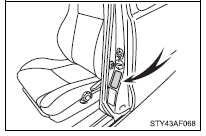
Tire inflation pressure
■ Tire inflation pressure
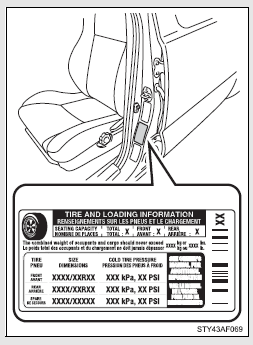
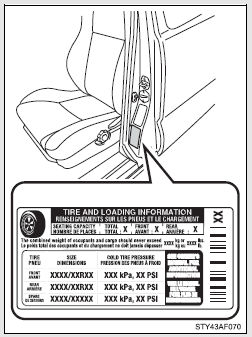
The recommended cold tire inflation pressure and tire size is displayed on the tire and loading information label.
 Regular Cab and Double Cab models
 Access Cab models
■ Inspection and adjustment procedure
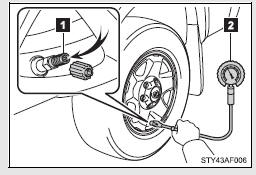
1. Tire valve
2. Tire pressure gauge
 Remove the tire valve cap.
 Press the tip of the tire pressure gauge onto the tire valve.
 Read the pressure using the graduations of the gauge.
 If the tire inflation pressure is not within the recommended levels, adjust inflate the tire.
If you add too much air, press the center of the valve to lower.
 After completing the tire inflation pressure measurement and adjustment, apply soapy water to the valve and check for leakage.
 Reinstall the tire valve cap.
■Tire inflation pressure check interval
You should check tire pressure every two weeks, or at least once a month.
Do not forget to check the spare.
■Effects of incorrect tire inflation pressure
Driving with incorrect tire inflation pressure may result in the following: ●Reduced fuel efficiency
●Reduced driving comfort and tire life
●Reduced safety
●Damage to the drive train
If a tire needs frequent refilling, have it checked by your Toyota dealer.
■Instructions for checking tire inflation pressure
When checking tire inflation pressure, observe the following: ●Check only when the tires are cold.
If your vehicle has been parked for at least 3 hours and has not been driven for more than 1 mile or 1.5 km, you will get an accurate cold tire inflation pressure reading.
●Always use a tire pressure gauge.
The appearance of the tire can be misleading. In addition, tire inflation pressures that are even just a few pounds off can degrade ride and handling.
●Do not bleed or reduce tire inflation pressure after driving. It is normal for the tire inflation pressure to be higher after driving.
●Never exceed the vehicle capacity weight.
Passengers and luggage weight should be placed so that the vehicle is balanced.
CAUTION
■Proper inflation is critical to save tire performance
Keep your tires properly inflated.
Otherwise, the following conditions may occur and result in an accident causing death or serious injury.
●Excessive wear
●Uneven wear
●Poor handling
●Possibility of blowouts resulting from overheated tires
●Poor sealing of the tire bead
●Wheel deformation and/or tire separation
●A greater possibility of tire damage from road hazards
NOTICE
■When inspecting and adjusting tire inflation pressure
Be sure to reinstall the tire valve caps.
Without the valve caps, dirt or moisture could get into the valve and cause air leakage, which could result in an accident. If the caps have been lost, replace them as soon as possible.
Wheels
If a wheel is bent, cracked or heavily corroded, it should be replaced.
Otherwise, the tire may separate from the wheel or cause loss of handling control.
■ Wheel selection
When replacing wheels, care should be taken to ensure that they are equivalent to those removed in load capacity, diameter, rim width, and inset*.
Replacement wheels are available at your Toyota dealer.
*: Conventionally referred to as “offset”.
Toyota does not recommend using: ● Wheels of different sizes or types
● Used wheels
● Bent wheels that have been straightened
■ Wheel precautions
● Use only Toyota wheel nuts and wrench designed for use with your aluminum wheels.
● When rotating, repairing or changing your tires, check that the wheel nuts are still tight after driving 100 miles (160 km).
● Be careful not to damage the aluminum wheels when using tire chains.
● Use only Toyota genuine balance weights or equivalent and a plastic or rubber hammer when balancing your wheels.
■When replacing wheels
The wheels of your Toyota are equipped with tire pressure warning valves and transmitters (except for spare tire) that allow the tire pressure warning system to provide advanced warning in the event of a loss in tire inflation pressure. Whenever wheels are replaced, the tire pressure warning valves and transmitters must be installed.
CAUTION
■When replacing wheels
●Do not use wheels that are a different size from those recommended in the Owner’s Manual, as this may result in loss of handling control.
●Never use an inner tube in a leaking wheel which is designed for a tubeless tire. Doing so may result in an accident, causing death or serious injury.
■When installing the wheel nuts
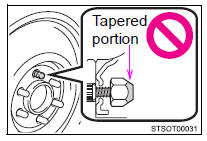
●Be sure to install the wheel nuts with the tapered end facing inward. Installing the nuts with the tapered end facing outward can cause wheel to break and eventually cause a wheel to come off while driving, which could lead to an accident resulting in death or serious injury.
●Never use oil or grease on the wheel bolts or wheel nuts.
Oil and grease may cause the wheel nuts to be excessively tightened, leading to bolt or disc wheel damage. In addition, the oil or grease can cause the wheel nuts to loosen and the wheel may fall off, causing an accident and resulting in death or serious injury. Remove any oil or grease from the wheel bolts or wheel nuts.
NOTICE
■Replacing tire pressure warning valves and transmitters
●Because tire repair or replacement may affect the tire pressure warning valves and transmitters, make sure to have tires serviced by your Toyota dealer or other qualified service shop. In addition, make sure to purchase your tire pressure warning valves and transmitters at your Toyota dealer.
●Ensure that only genuine Toyota wheels are used on your vehicle.
Tire pressure warning valves and transmitters may not work properly with non-genuine wheels.
Air conditioning filter
The air conditioning filter must be changed regularly to maintain air conditioning efficiency.
■ Removal method
 Turn the engine switch to the LOCK position.
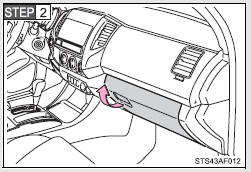
Open the glove box.
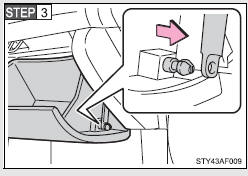
Slide off the damper.
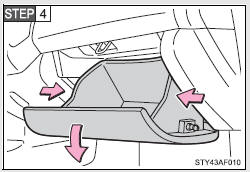
Push in each side of the glove box to disconnect the claws.
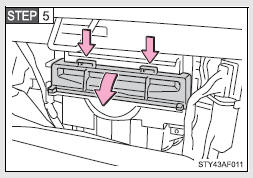
Open the filter door.
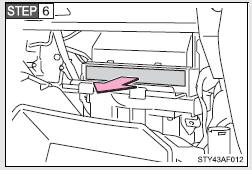
Remove the filter.
■ Replacement method
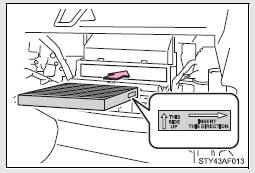
Remove the air conditioning filter and replace it with a new one.
When installing the filter, follow the instructions indicated on the label.
■Checking interval
Inspect and replace the air conditioning filter according to the maintenance schedule. In dusty areas or areas with heavy traffic flow, early replacement may be required. (For scheduled maintenance information, please refer to the “Scheduled Maintenance Guide” or “Owner’s Manual Supplement”.)
■If air flow from the vents decreases dramatically
The filter may be clogged. Check the filter and replace if necessary.
NOTICE
■When using the air conditioning system
Make sure that a filter is always installed.
Using the air conditioning system without a filter may cause damage to the system.
Wireless remote control battery
Replace the battery with a new one if it is discharged.
■ You will need the following items:
Lithium battery CR2032
■ Replacing the battery
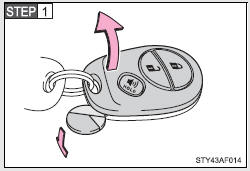
Remove the cover using a coin protected with tape etc.
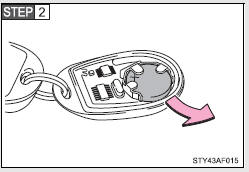
Remove the discharged transmitter battery.
Insert a new battery with the “+” terminal facing up.
■If the wireless remote control battery is discharged
The following symptoms may occur.
●The wireless remote control will not function properly.
●The operational range is reduced.
■Use a CR2032 lithium battery
●Batteries can be purchased at your Toyota dealer, jewelers, or camera stores.
●Replace only with the same or equivalent type recommended by your Toyota dealer.
●Dispose of used batteries according to the local laws.
CAUTION
■Removed battery and other parts
These parts are small and if swallowed by a child, they can cause choking.
Keep away from children. Failure to do so could result in death or serious injury.
■Certification for the lithium battery
RISK OF EXPLOSION IF BATTERY IS REPLACED BY AN INCORRECT TYPE. DISPOSE OF USED BATTERIES ACCORDING TO THE INSTRUCTIONS
NOTICE
■For normal operation after replacing the battery
Observe the following precautions to prevent accidents.
●Always work with dry hands.
Moisture may cause the battery to rust.
●Do not touch or move any other components inside the remote control.
●Do not bend either of the battery terminals.
Checking and replacing fuses
If any of the electrical components do not operate, a fuse may have blown. If this happens, check and replace the fuses as necessary.
 Turn the engine switch to the LOCK position.
 The fuses are located in the following places. To check the fuses, follow the instructions below.
 Engine compartment
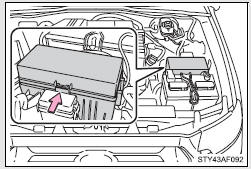
Push the tab in and lift the lid off.
 Under the instrument panel
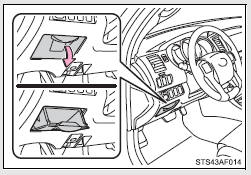
1.Open the auxiliary box.
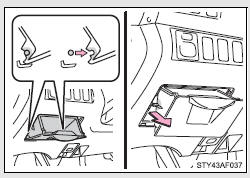
2.Pull up the box and disengage the claws. Remove the stoppers from the cutouts and remove the box.
 After a system failure, see “Fuse layout and amperage ratings” (→P. 455) for details about which fuse to check.
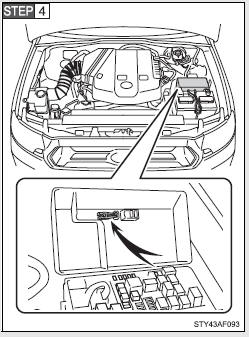
Remove the fuse with the pullout tool.
 Check if the fuse has blown.
 Type A
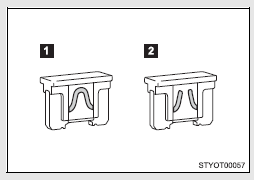
1. Normal fuse
2. Blown fuse
Replace it with one of an appropriate amperage rating.
The amperage rating can be found on the fuse box lid.
 Type B
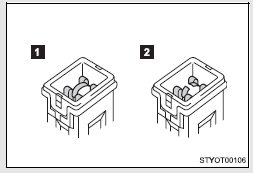
1. Normal fuse
2. Blown fuse
Replace it with one of an appropriate amperage rating.
The amperage rating can be found on the fuse box lid.
 Type C
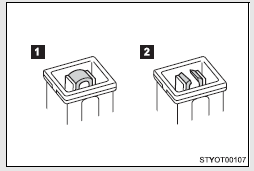
1. Normal fuse
2. Blown fuse
Replace it with one of an appropriate amperage rating.
The amperage rating can be found on the fuse box lid.
 Type D
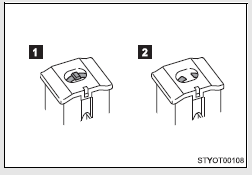
1. Normal fuse
2. Blown fuse
Replace it with one of an appropriate amperage rating.
The amperage rating can be found on the fuse box lid.
Fuse layout and amperage ratings
■ Engine compartment
 Type A
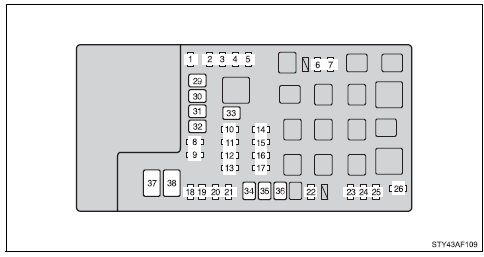
 Type B
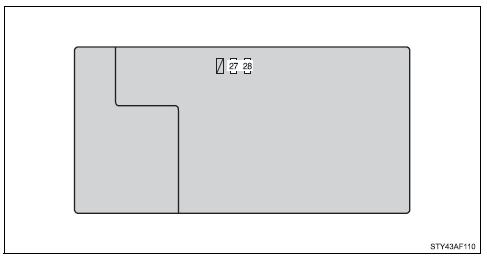
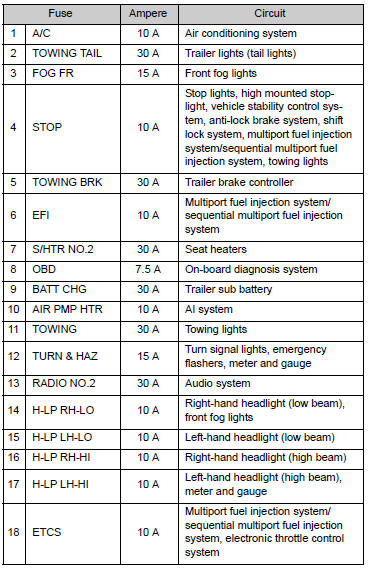
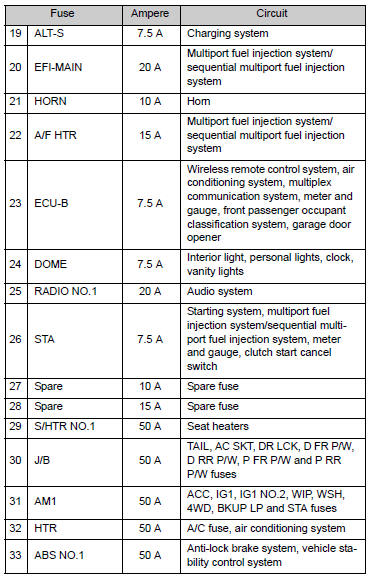
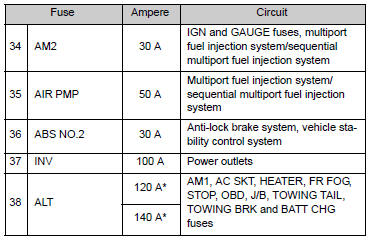
*: Replace the fuse with one of the same ampere rating as the original
■ Under the instrument panel
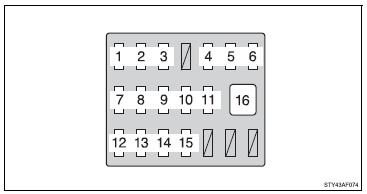
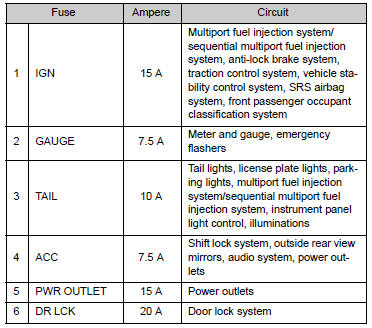
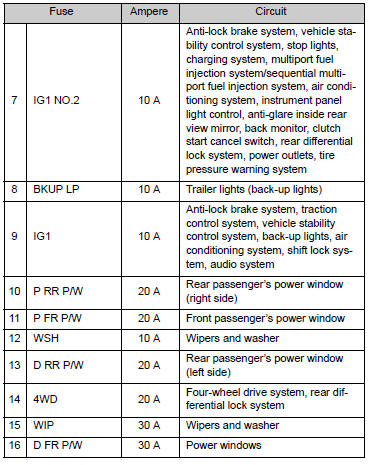
■After a fuse is repl
●If the lights do not turn on even after the fuse has been replaced, a bulb may need replacement.
●If the replaced fuse blows again, have the vehicle inspected by your Toyota dealer.
■If there is an overload in the circuits
The fuses are designed to blow, protecting the wiring harness from damage.
CAUTION
■To prevent system breakdowns and vehicle fire
Observe the following precautions.
Failing to do so may cause damage to the vehicle, and possibly a fire or injury.
●Never use a fuse of a higher amperage rating than indicated, or use any other object in place of a fuse.
●Always use a genuine Toyota fuse or equivalent.
Never replace a fuse with a wire, even as a temporary fix.
●Do not modify the fuse or the fuse box.
NOTICE
■Before replacing fuses
Have the cause of electrical overload determined and repaired by your Toyota dealer as soon as possible.
Light bulbs
You may replace the following bulbs yourself. The difficulty level of replacement varies depending on the bulb. If necessary bulb replacement seems difficult to perform, contact your Toyota dealer.
For more information about replacing other light bulbs, contact your Toyota dealer.
■ Prepare a replacement light bulb
Check the wattage of the light bulb being replaced.
■ Front bulb locations
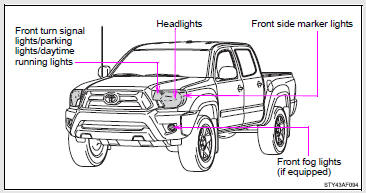
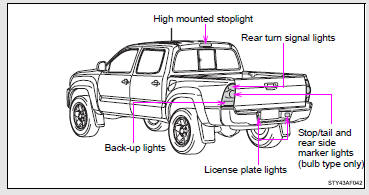
■ Rear bulb locations
Replacing light bulbs
■ Headlights
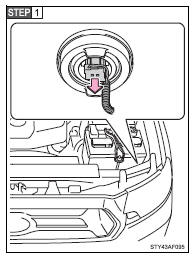
Unplug the connector.
Remove the rubber cover.
Release the bulb retaining spring.
Remove the bulb.
To install a new bulb, align the tabs of the bulb with the cutouts of the mounting hole.
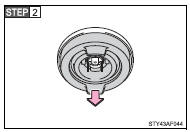
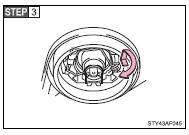
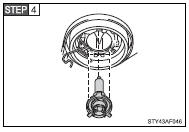
■ Front fog lights (if equipped)
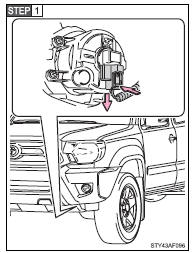
Unplug the connector while pulling the lock release.
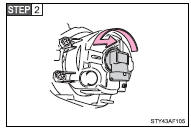
Turn the bulb counterclockwise.
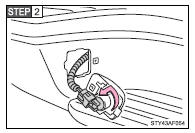
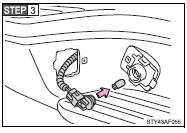
■ Front side marker lights
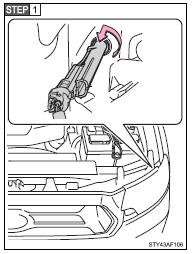
Turn the bulb base counterclockwise.
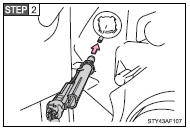
Remove the light bulb.
■ Front turn signal lights/parking lights/daytime running lights
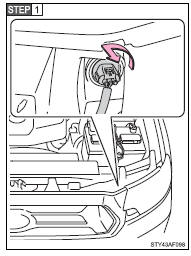
Turn the bulb base counterclockwise.
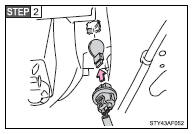
Remove the light bulb.
■ Stop/tail lights, rear side marker lights (bulb type only), backup lights and rear turn signal lights
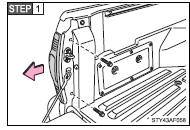
Remove the bolts and rear combination assembly.
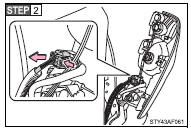
Unplug the connector while depressing the lock release.
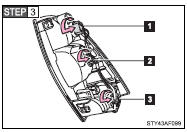
Turn the bulb bases counterclockwise.
1. Rear turn signal light
2. Stop/tail and rear side marker lights (bulb type only)
3. Back-up light
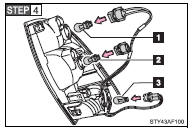
Remove the light bulb.
1. Rear turn signal light
2. Stop/tail and rear side marker lights (bulb type only)
3. Back-up light
■ High mounted stoplight
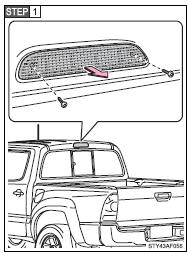
Remove the screws and cover.
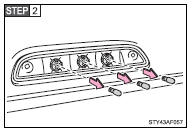
Remove the light bulbs.
■ License plate lights
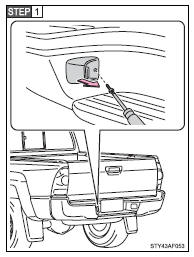
Remove the screw and light unit.
Turn the bulb base counterclockwise.
Remove the light bulb.
■ Lights other than the above
If any of the lights listed below has burnt out, have it replaced by your Toyota dealer.
• Side turn signal lights (if equipped)
• Stop/tail lights (LED type)
• Rear side marker lights (LED type)
■Condensation build-up on the inside of the lens
Temporary condensation build-up on the inside of the headlight lens does not indicate a malfunction. Contact your Toyota dealer for more information in the following situations: ●Large drops of water are built up on the inside of the lens.
●Water has built up inside the headlight.
■LED light bulbs
The side turn signal lights (if equipped), stop/tail and rear side marker lights (LED type) consist of a number of LEDs. If any of the LEDs burn out, take your vehicle to your Toyota dealer to have the light replaced.
If two or more LEDs in a stop light burn out, your vehicle may not conform to local laws (SAE).
CAUTION
■Replacing light bulbs
●Turn off the headlights. Do not attempt to replace the bulb immediately after turning off the headlights.
The bulbs become very hot and may cause burns.
●Do not touch the glass portion of the light bulb with bare hands. When it is unavoidable to hold the glass portion, use and hold with a clean dry cloth to avoid getting moisture and oils on the bulb.
Also, if the bulb is scratched or dropped, it may blow out or crack.
●Fully install light bulbs and any parts used to secure them. Failing to do so may result in heat damage, fire, or water entering the headlight unit. This may damage the headlights or cause condensation to build up on the lens.
■To prevent damage or fire
Make sure bulbs are fully seated and locked.
Stored owner’s manualImported HTML from the shared Autotk manuals tables. Not an official Toyota site.